
Steam Room vs. Dry Sauna: Why the Environment Matters
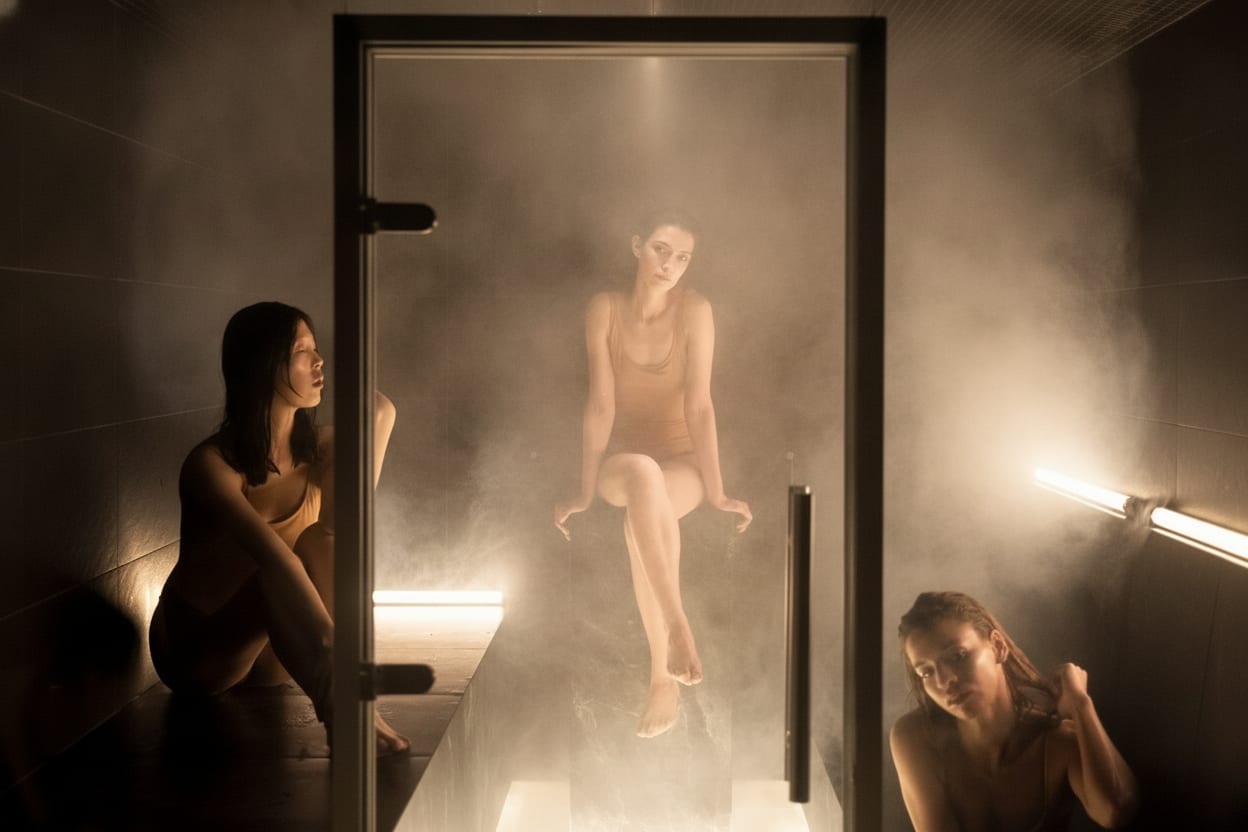
Before choosing a cladding material, it helps to understand what your wood will actually face. A dry sauna runs hot — typically 70–100°C — but the relative humidity stays low, often below 20%. Wood in that environment cycles between hot and dry, which causes its own stresses, but condensation is rarely the problem.
A steam room is a different animal entirely. Temperatures are milder, usually 40–45°C, but relative humidity hovers at or near 100%. Condensation forms on every surface for the duration of every session. That sustained saturation is what destroys most cladding materials over time — not heat, but relentless moisture.
Why Most Wood Fails in a Steam Room
Wood is hygroscopic: it absorbs and releases moisture as humidity changes. In a steam room, that cycle is extreme and frequent. Common problems include:
- Swelling and dimensional movement — boards gap when dry, buckle when wet if expansion space isn't built in.
- Mould and mildew — untreated or poorly sealed wood surfaces provide exactly the conditions fungi need: warmth, moisture, and organic matter.
- Rot — prolonged saturation degrades cell structure in most softwoods within a few years if ventilation is poor.
- Tannin staining — many species leach dark tannins onto walls and benches when wet, leaving permanent marks.
Pine, spruce, and most unsealed hardwoods are poor choices for direct steam exposure. Even species used successfully in dry saunas — such as aspen or alder — can struggle when condensation is constant rather than intermittent.
Why Teak Performs Better
Teak (Tectona grandis) has been used in marine environments — boat decks, hulls, wet-dock furniture — for centuries precisely because of its behaviour in sustained moisture. Three properties make it stand out in a steam-room context:
High Natural Oil Content
Teak contains a high concentration of natural oils and silica within its cellular structure. These oils act as an internal water repellent, slowing moisture uptake significantly compared with most timbers. Boards resist saturation rather than absorbing it passively.
Low Dimensional Movement
Teak's tangential shrinkage rate is among the lowest of any commercial hardwood — roughly 4–5% from green to oven-dry. In practical terms, correctly installed teak boards with appropriate expansion gaps move very little between dry and saturated states. Boards stay flat; joints stay tight.
Natural Resistance to Rot and Fungi
Teak is classified as naturally durable (Class 1 under European durability standards for solid wood). Its natural oils inhibit the fungal growth that causes rot. This is not indefinite protection, but it is a substantial head start over untreated softwoods.
Honest Trade-Offs
Teak is not a maintenance-free material, and it is not a structural substitute for tiles or waterproof wall systems. A few things to be clear about:
- Cost — Teak commands a significant price premium over pine, cedar, or thermally modified timber. The cost is real and worth factoring into your budget from the start.
- Natural silvering — Unfinished teak weathers to a silver-grey over time. In a steam room with no UV exposure this process is slower, but the honey-gold colour does fade without periodic oiling. This is a cosmetic change, not a structural one — the timber remains sound — but if colour matters to you, plan for maintenance oiling.
- Vapour barrier is still essential — Teak cladding is not a waterproof membrane. The wall system behind any timber steam-room lining must include a proper vapour barrier (typically a continuous sheet of polyethylene or similar) to protect insulation and framing from the moisture that will inevitably migrate through the wood. Teak slows moisture ingress; it does not stop it.
- Expansion gaps — Even with teak's low movement, boards must be installed with adequate expansion gaps (typically 3–5 mm depending on board width and ambient humidity). Boards installed tight will eventually push against each other.
Brief Comparison: Teak vs. Thermally Modified Timber vs. Cedar
Thermally Modified Timber (TMT)
TMT is softwood or hardwood that has been heat-treated at 180–230°C to drive out the sugars and moisture that feed rot and mould. It has good dimensional stability and improved durability, costs less than teak, and takes stain evenly. The trade-off is that it can be more brittle than untreated wood, and its durability depends on the modification depth and process quality — which varies between suppliers.
Western Red Cedar
Cedar is the traditional Scandinavian-sauna interior wood and performs adequately in dry saunas. In a steam room, however, cedar's lower natural oil content and higher porosity mean it absorbs moisture more readily than teak. It will require more frequent oiling — 3–6 times a year in high-humidity environments — and needs careful attention to prevent mould in persistently wet conditions. Cedar also tends to grey and weather more quickly.
Summary
Teak offers the best inherent resistance to the steam-room environment among these three, but at the highest cost. TMT is a credible middle-ground option if budget is a constraint and the product is properly sourced. Cedar works for dry saunas and can be used in steam rooms with diligent maintenance, but it is the least forgiving of the three in constant-condensation conditions.
Maintenance Expectations
To keep teak looking its best and extend its service life in a steam room:
- Oil annually — Apply a food-safe teak oil or a penetrating hardwood oil once a year as a minimum. If the wood looks dry or begins to grey noticeably, oil sooner.
- Clean regularly — Wipe down surfaces after sessions to remove condensation and any soap or product residue. This is the single most effective thing you can do to prevent mould.
- Inspect quarterly — Check expansion gaps, look for any boards that have lifted or show dark staining, and verify that the seals around the door frame and any penetrations are intact.
- Ventilate after use — Leave the steam-room door open after each session to allow surfaces to dry before the next use. Sustained surface saturation is what accelerates degradation, not the session itself.
Properly maintained teak cladding in a steam room can last well over two decades. Neglected teak — no oiling, no ventilation, no cleaning — will deteriorate much faster.
Is Teak the Right Choice for You?
Teak is genuinely one of the best wood species for a steam-room interior — but choosing wood over tile is an aesthetic and sensory decision, not a purely practical one. Wood feels warmer underfoot and to the touch, it looks natural, and it moderates the acoustic harshness of a hard-surfaced room. Teak adds a longevity and low-maintenance advantage over other woods in that role. What it does not do is eliminate maintenance, replace a proper waterproof wall system, or justify skipping the vapour barrier.
If you are considering a custom sauna or steam room build and want to explore teak as an interior or exterior cladding option, you can design and price your build using our free online 3D designer. For specific questions, reach us at sales@sauna.in.th.