
Important Liability Notice — Please Read Before Anything Else
Sisu Sauna does not carry out, supervise, certify or take any responsibility for external electrical connections. All wiring from your supply panel to the sauna — including the dedicated circuit, breaker installation, RCD fitting and any cabling outside the sauna unit itself — must be designed and installed by a licensed electrician who holds the appropriate certification under Thai law. This is not a preference or a recommendation: it is a legal requirement, and our liability ends at the sauna unit. We will never instruct you to wire a circuit yourself, and nothing in this article should be read as a substitute for a professional electrical assessment of your specific site. If any contractor or individual offers to connect your sauna to mains supply without a current electrical licence, do not proceed.
Before You Wire Anything — Read This First
A sauna heater draws sustained, high current for long periods. Unlike a kettle or air conditioner that cycles on and off, a sauna heater runs at full load until the room reaches temperature and then holds it there — often for an hour or more. That sustained draw is what makes electrical preparation so important, and so unforgiving when it is done badly.
Undersized wiring does not just trip a breaker. It heats up inside your wall, degrades insulation over months and years, and can start a fire with no warning. An incorrectly rated breaker may allow that process to continue long past the point where it should have interrupted the circuit. This is not a place to improvise, use leftover cable, or skip the licensed electrician.
Compliance note: All sauna electrical work in Thailand must comply with the standards of the Provincial Electricity Authority (PEA) or Metropolitan Electricity Authority (MEA). Always use a licensed electrician. The information below is a reference guide to help you brief your electrician — not a substitute for a professional assessment of your site.
The Two Main Sauna Types and Why They Draw Power So Differently
There are two fundamentally different sauna heating technologies, and their electrical demands are very different.
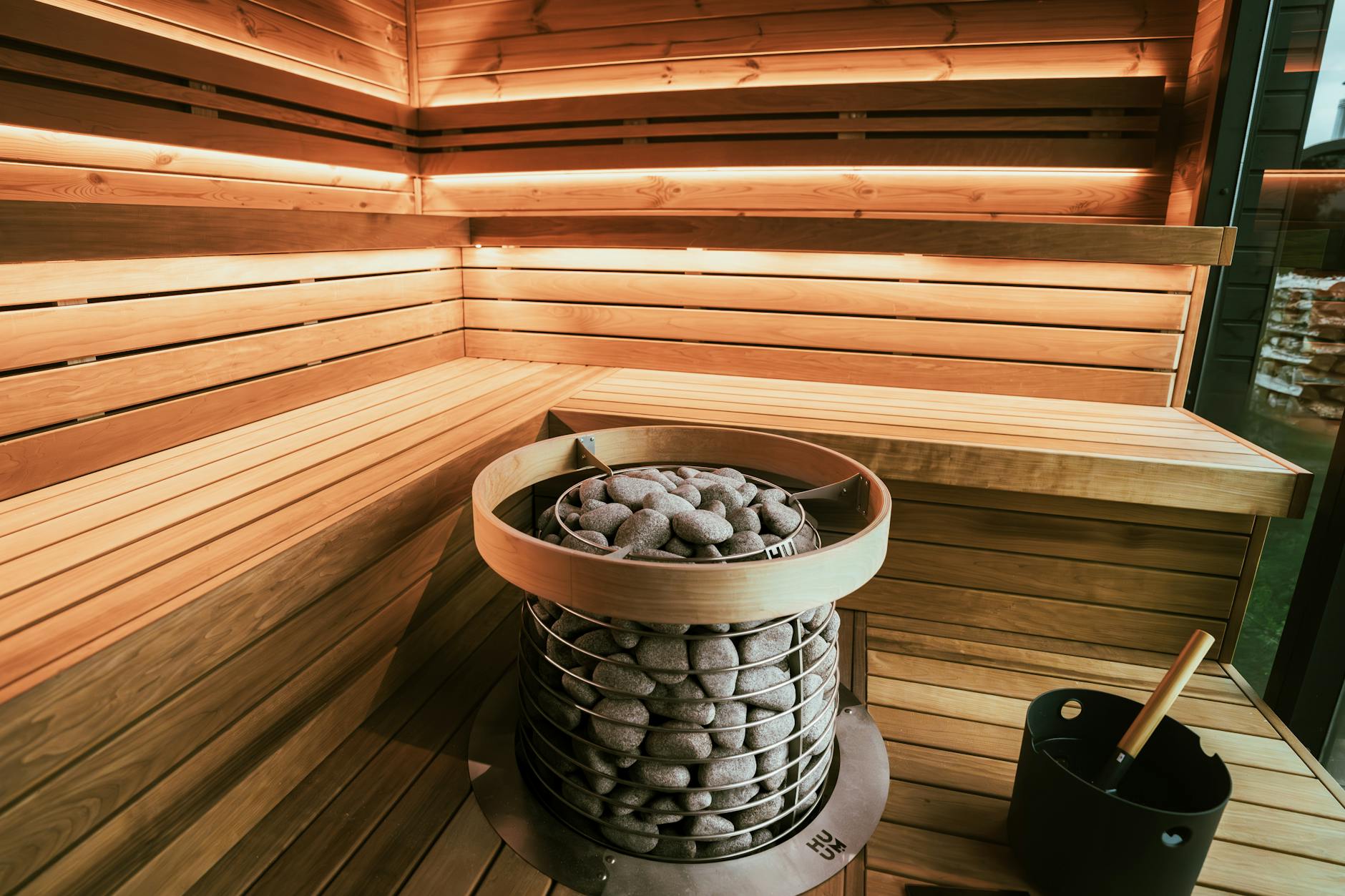
Traditional dry/steam saunas use an electric resistance heater to heat a large mass of stones. The stones radiate intense heat (80–100 °C), and the heater works hard to get them there and keep them there. These heaters are rated from around 3 kW for a small personal sauna up to 9 kW and beyond for large or commercial rooms.
Infrared (IR) saunas use infrared panels to warm the body directly rather than heating the air first. Because they do not need to heat a mass of stones and do not need to reach the same air temperature (typically 45–60 °C), their total power draw is roughly one-third that of a comparable traditional heater. A two-person IR cabin may draw only 1.5–2.5 kW where a traditional sauna of the same size would need 4.5–6 kW.
This difference matters enormously for your circuit planning — IR saunas are often viable on an existing 16 A circuit, while traditional heaters almost always need a dedicated circuit sized specifically for them.
Heater Size Reference Guide
The tables below show typical heater ratings by room size, the dedicated circuit breaker normally paired with them, and the minimum cable cross-section for a standard 230 V single-phase supply in Thailand. Treat these as starting-point references — your electrician must confirm the actual cable size based on run length and local conditions.
Infrared (IR) Panels — 230 V Single-Phase
1–2 person cabin, 1.2–2.5 kW — Breaker: 16 A minimum — Cable: 2.5 mm² copper
2–4 person cabin, 2.5–4.0 kW — Breaker: 20 A minimum — Cable: 4.0 mm² copper
Electric Dry Heater — Single-Phase (most Thai homes)
1–2 person room, 3–4.5 kW — Breaker: 25 A minimum — Cable: 4.0 mm² copper
2–4 person room, 4.5–6 kW — Breaker: 32 A minimum — Cable: 6.0 mm² copper
4–6 person room, 6–9 kW — Breaker: 40 A minimum — Cable: 10.0 mm² copper
Electric Dry Heater — Three-Phase (large or commercial)
Large or commercial room, 9 kW+ — Breaker: 3 × 20 A minimum — Cable: per licensed engineer
Cable sizes above assume short runs under 15 m. Longer runs increase voltage drop and may require a larger cross-section. Your electrician must confirm the correct size for your installation.
Single-Phase vs Three-Phase
Most Thai homes have a single-phase 230 V supply. This is perfectly adequate for any sauna heater up to 9 kW — which covers almost all residential installations. Our 3D sauna builder shows the exact electrical load for your chosen heater as you design, so there are no surprises when you brief your electrician.
Heaters above 9 kW and up to 24kw — which you would typically only encounter in a large commercial or semi-commercial setup — require a three-phase supply. If you are considering a large sauna for a spa, resort or multi-user facility, confirm your supply phase with a licensed electrician before ordering.
Dedicated Circuit — Not Optional
A sauna heater must always run on its own dedicated circuit — a circuit that feeds nothing else. Sharing a circuit with lighting, air conditioning or other appliances is dangerous and will likely result in nuisance tripping at best, and overloaded wiring at worst.
The dedicated circuit must include:
A correctly rated circuit breaker with overcurrent and short-circuit protection (see examples above)
A residual current device (RCD / ELCB) rated at 30 mA — mandatory for any circuit in a wet or high-humidity area
An isolation switch positioned close to the sauna and accessible in an emergency
Heat-resistant cable rated for the ambient temperatures near a sauna installation
The Heater Control Unit
Most modern sauna heaters include a control unit that manages temperature and timer settings. This unit will specify its own minimum supply requirements — your electrician should read the manufacturer data sheet and confirm the wiring configuration before connecting. Sisu Sauna supplies heaters sized to your room; the load specification is confirmed at the design stage and included in the documentation we provide.
What Can Go Wrong — and How Badly
The consequences of getting sauna wiring wrong are serious:
Undersized cable — resistive heating in the wire itself, insulation breakdown, fire risk inside walls
Oversized breaker — the protection device allows dangerous current to flow before tripping; the breaker protects the cable, not the heater
No RCD — in a hot, potentially damp environment a ground fault without RCD protection is a serious electrocution risk
Shared circuit — voltage drop, nuisance tripping, and overloaded shared wiring
Unlicensed connections — loose or incorrect terminations arc and generate heat; in a timber sauna structure, the consequences are obvious
The Practical Takeaway
Know your heater type and wattage before you plan the circuit. Use the reference data above to have an informed conversation with your licensed electrician, and have them assess the actual run length and your existing board capacity. For all Sisu Sauna builds, the 3D designer outputs the exact electrical specification for your chosen heater — use that document when briefing your electrician.
Done properly by a qualified professional, sauna electrics are straightforward. Done badly, they are genuinely dangerous. The cost of a licensed electrician is a small fraction of a sauna build — and an even smaller fraction of what goes wrong if the wiring fails.