
Why the top bench is hotter — and why that is the point
Sixty degrees on the lower bench. Eighty on the upper.
Same room. Same heater. Same moment. That difference is not a calibration error or a design fault. It is the room doing exactly what it should.
Why the air layers, and stays layered
Hot air is lighter than cold air. Near the stones, density drops to roughly 0.75 kg/m³, against about 1.29 kg/m³ at freezing. Lighter air floats.
It rises off the heater, runs along the ceiling, falls down the far wall, and returns along the floor. A slow convection loop, driven by nothing but the difference between hot and cold. In a well-built sauna there are no draughts to disrupt it, so the layers never mix.
That is your insulation and tight construction working, not failing.
How big a difference to expect
The rule of thumb is 3 to 5 °C per 100 mm of height. It holds regardless of room size, because it is a property of buoyant air rather than of the cabin.
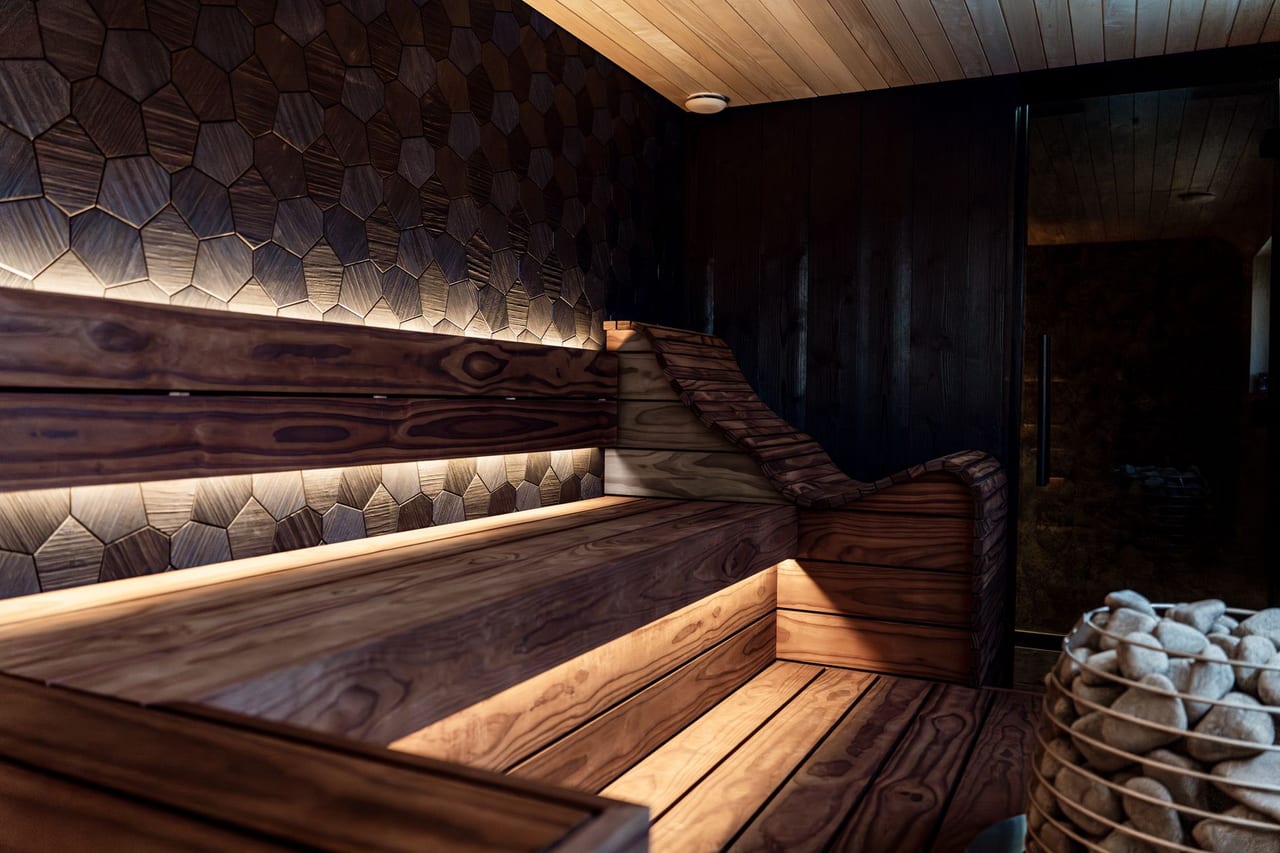
With tiers set 450 mm apart, that puts the upper bench roughly 15 to 25 °C above the lower, in any sauna, at any scale. Measure at the floor and the spread is wider again — 40 to 55 °C from floor to ceiling is ordinary.
Sit on the floor of a sauna reading 90 °C at head height and you may be sitting in 40 °C air. Same room, same minute.
One room, several microclimates
That gradient is not a problem to be solved. It is a feature that costs nothing.
Three people can sit in the same room, at the same time, and have genuinely different sessions.
Anyone who overheats easily stays on the lower bench.
Anyone who wants to push harder moves up.
Children sit low. Finnish practice has always put them there, precisely because stratification makes the lower bench gentler.
Instead of opening the door and dumping heat for everybody, you drop a tier. The session continues. The room stays hot. Your core keeps warming even as the intensity drops — which is often exactly what somebody needs at minute twelve.
Commercial saunas and Russian banyas have always built multiple levels for this reason. It is not a luxury detail. It is the simplest thermostat in the building, and it has no moving parts.
The löyly twist — the top bench takes the hit
Throwing water does not raise air temperature in any meaningful way. What it does is raise humidity, from around 10 to 15 per cent up to 40 to 60 per cent, within seconds.
The heat you feel is latent heat — roughly 2,260 kJ per kilogram — released as steam condenses on your skin, combined with your sweat no longer evaporating freely. That is why 80 °C with löyly beats 90 °C dry. The thermometer barely moves. You certainly do.
And the steam rises as a column, hits the ceiling, spreads outward, and rolls back down. It lands on the top bench first.
The top bench is not hotter because it is higher. It is hotter because it is in the way of everything that rises.
Stratification is not stagnation
Some people describe the temperature difference between benches as a symptom of poor ventilation, and argue it should be engineered away. That conflates two different things.
Stratification is buoyancy. Hot air floats, it will always float, and no ventilation strategy eliminates it. Nor should one try.
Stagnation is a genuine fault: stale air, dead cold pockets that shift from one session to the next, humidity that never clears between rounds.
When somebody says their sauna has a ventilation problem, they usually mean stagnation. They are using the wrong word. The fix for stagnation is fresh air exchange. The fix for stratification is to move to a different bench.
Know your own numbers
When a sauna is first brought up to temperature, take four readings: both benches, at both ends of the room. Note the date and the time from cold start, and fix the card to the wall.
Measure late rather than early. Stone lags air by a considerable margin, and the lower bench is the last thing in the room to come up. Sixty to ninety minutes from cold, depending on how much stone you are heating.
What to expect:
Upper bench roughly 15 to 25 °C above the lower, with tiers at 400 to 500 mm.
Floor another 20 °C or so below the lower bench.
End to end, a couple of degrees in a small cabin, up to eight or ten in a long room with the heater at one end.
None of it is a fault. It is the gradient doing what gradients do. But it is worth having on paper, because sooner or later somebody will say the sauna feels different — and a dated card settles in ten seconds what an argument will not settle at all.
One last thing worth knowing: most people arguing about their sauna temperature are really arguing about their thermometer. A cheap bimetal dial can read ten degrees out and drift with humidity. Before you conclude anything about your benches, be sure about your instrument.
If you are designing a sauna and want to see how bench height and room volume shape the gradient before anything is built, the 3D designer at sisusauna.app updates the layout in real time as you adjust dimensions. Or write to us at sales@sauna.in.th and we will work through the numbers with you.