


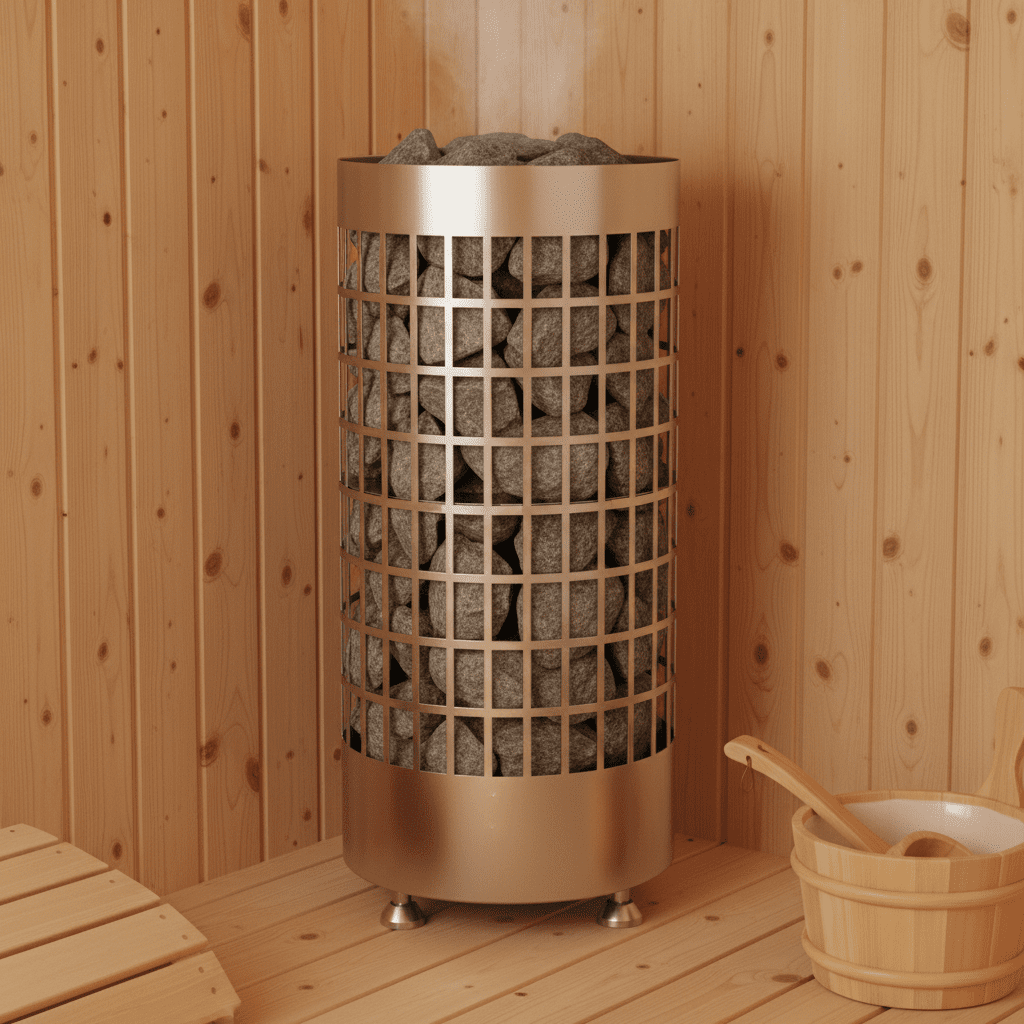


If you’re thinking about buying a sauna heater in Thailand, start by checking your electrical supply, determining your current load, and confirming whether you need three-phase power. This guide will help you through each step so you don’t run into problems.
I often talk to people who are buying a sauna, and the conversation usually goes like this.
They’ve chosen the right size and picked out their timber. They’re excited. Then, almost as an afterthought, they ask, “I just need a normal plug for the heater, right?”
No, it’s not that simple.
A sauna heater uses a lot of power—more than six air conditioners running at once. You’ll need a dedicated circuit, the right wiring, and maybe even an electrical upgrade before you install it.
I’m not trying to scare you. I just want to help you avoid buying a heater you can’t use or having an electrician install it incorrectly.
Let’s break down the process step by step so you can make sure. First, check what kind of electrical supply your home has before you do anything else.
In Thailand, residential properties are supplied by either the Metropolitan Electricity Authority (MEA, which covers Bangkok and surrounding areas) or the Provincial Electricity Authority (PEA, which supplies power to the rest of the country). Both MEA and PEA typically supply single-phase electricity to most standard homes and units. (Single-phase supply provides one alternating current supply to the property, which is standard for most residential buildings.)
Single-phase power in Thailand runs at 220–240V. Your main switchboard shows your supply type and main breaker rating.
To find out what you’re working with:
– Locate your main switchboard (usually a grey box mounted on an exterior wall, inside a meter room, or near your front door).
Look for the main circuit breaker at the top of the board. This device, measured in amperes (A), is often labelled with values like 30A, 50A, or 63A in standard homes; larger properties may have higher ratings. The breaker limits the amount of current that can safely enter your property.
If you see two rows of breakers and a main switch labelled as 3-phase (or สามเฟส, pronounced sam fen in Thai), you already have three-phase power. Three-phase power supplies three alternating currents instead of one, which supports higher loads for large appliances.
– If you’re in a condo or serviced apartment, ask building management — your supply may be metered and limited at a fixed capacity.
If you’re not sure, an electrician can check your supply in about 10 minutes with a clamp meter, a device that measures electrical current without disconnecting wires.
After you confirm your supply, the next crucial step is to check your home’s electrical capacity.
Every electrical appliance in your home draws current. Your air conditioners, water heaters, ovens, EV chargers, they all add up. The total electrical load must stay within the capacity of your main breaker and the limits set by your provider, either MEA or PEA. According to the Board of Investment Thailand, your electrical wiring and equipment must meet the standards set by the Engineering Institute of Thailand or the Provincial Electricity Authority to be approved for power distribution.
To estimate your available headroom, start by noting your main breaker’s amperage, such as 63A at 220V.
Multiply by 0.8 to find your safe working capacity. Electrical circuits shouldn’t run at full load all the time. Using 80% helps prevent overheating and keeps things safe.
Add up the running current (measured in amperes) of your major appliances. Each 1 kilowatt (kW) of load draws approximately 4.5A at 220V. Appliance examples:
Air conditioner (1.5 HP—horsepower) ≈ 8–10A
Air conditioner (2.5 HP) ≈ 13–16A
Electric water heater ≈ 8–10A
Washing machine ≈ 5–8A
Step 4: Subtract your existing load from your usable capacity. What’s left is what’s available for a sauna heater.
Example: 50.4A usable − 30A existing load = 20.4A available. That’s enough for a 4.5kW heater (≈21A) on the edge, or safely for a 3kW heater (≈14A).
If your numbers are close, an electrician can do a live-load test to see how much power is actually being used at peak times. This is much better than just guessing. Now, match your available capacity with potential sauna heater sizes to see what’s possible.
Each heater has a set wattage, which indicates how much current it draws. Because Thailand’s climate can impact sauna heating requirements, it’s recommended to use the standard sizing guide for your sauna’s internal volume and add about 20 percent to the heater size for rooms that are outdoors or have a lot of glass, according to Sisu Saunas. Most Thai homes may also require a slightly larger heater compared to those in Europe due to differences in insulation. Here is the current draw (in amperes, A) for each heater size at 220V single-phase:
Heater | Room Volume (m; cubic meters³) | Current Dra (A)w | Recommended Breake (A)r
3kW| 2–4 m³ | ~14A | 16A
4.5kW | 3– m³ | ~21A | 25A
6kW | 5–8 m³ | ~28A | 32A
9kW | 8–11 m³ | ~41A | 50A
10.5kW | 9–13 m³ | ~48A | 50A
12kW | 11–15 m³ | ~55A | 63A
15kW | 13–1 8m | Three-phase only
18kW| 15–20 m³ | Three-phase only
If you’re choosing a heater for Thailand, always pick one size bigger than the European recommendation. For example, a room that needs a 6kW heater in Helsinki will need at least a 6–9kW heater in Chon Buri.
Now that you know the heater size, review the cable and breaker requirements for safe installation. Each heater size needs its own dedicated circuit, with a single cable running from the heater to its own breaker.
The cable cross-section (measured in square millimetres, mm²) and circuit breaker rating (in amperes, A) must match the heater’s current draw. If the cable is too small, it can overheat due to electrical resistance, posing a fire risk.
Heater | Cable (mm²) | Breaker
3kW | 2.5mm² | 16A
4.5kW | 4mm² | 25A
6kW | 6mm² | 32A
9kW | 10mm² | 50A
10.5kW | 10mm² | 50A
12kW | 16mm² | 63A
15kW | 4mm² per phase (3-phase) | 25A per phase
18kW | 6mm² per phase (3-phase) | 32A per phase
Cables longer than 15 metres need to be uprated by one size to compensate for voltage drop. Your electrician will calculate this based on the actual run distance.
The heater also needs an isolation switch within line of sight of the unit. This is required under the Thai electrical code and should be a 2-pole type that cuts both the live and neutral conductors.
Everything must be hardwired. You can’t use a plug, extension lead, or any shortcuts.
If you’re unsure whether your setup can handle your chosen heater, check whether it requires three-phase power.
If your heater is 15kW or 18kW, the answer is simple: you need three-phase power. Single-phase supply in Thailand cannot practically handle more than 12kW as a dedicated circuit.
For heaters between 9kW and 12kW, single-phase is possible, but your total electrical capacity must support it. If your main supply is only 30A, a 9kW heater alone would use up nearly your entire capacity.
Here’s a straightforward checklist:
– Heater is 15kW or 18kW → three-phase required.
– Heater is 9kW–12kW and your main supply is below 50A → check total load carefully, may need upgrade.
– Heater is 6kW or below → single-phase is almost always fine.
– Your property is a standalone house → check both phases and capacity.
– Your property is a condo → confirm with building management whether your unit supply allows the additional load.
According to our information, many older houses in Thailand with a 30A or 40A single-phase electrical supply may only be able to accommodate a sauna heater up to 6kW unless the electrical system is upgraded, as these heaters typically require a dedicated circuit within that amperage range. For most home saunas, 6kW is genuinely enough; it’ll heat a well-insulated 3–5m³ room to 85–90°C without a problem.
If a three-phase upgrade is necessary, here’s how to approach it in Thailand.
If you need three-phase power and don’t have it yet, the process in Thailand is fairly straightforward, but it does take time. upgrade. You’ll need your property ownership documents (Chanote or title deed) and existing meter information.
- MEA/PEA inspects the property and determines whether the infrastructure in your street or building can support three-phase. In established suburban areas, this is usually available.
- You pay a connection fee. This varies by distance from the nearest three-phase supply and the size of the installation. Budget ฿15,000–฿50,000+ depending on your location and the work involved.
- Once MEA/PEA installs the new supply and meter, your licensed electrician upgrades your main switchboard and runs the circuit to the heater.
According to the Board of Investment of Thailand, once your application and payment are complete, electrical meter installation and power distribution in rural areas should be finished within 5 working days. If your sauna plans require more power, such as for a larger unit, you should request a three-phase supply when applying for your building permit. It’s much cheaper to install it from the start than to upgrade later. Let’s find out how to choose a qualified electrician for your sauna heater.
This is where many installations run into problems. Installing a sauna heater isn’t hard for a qualified electrician, but it does require someone who knows about high-current circuits, thermal loads, and the right cable size for appliances that run for long periods.
A sauna heater runs at full power for 30 to 60 minutes at a time, unlike an air conditioner that turns on and off. The cable and breaker need to be rated for continuous use, not just short bursts.
What to look for when hiring:
– Licensed electrical contractor (ช่างไฟฟ้า มีใบอนุญาต). In Thailand, contractors doing work over a certain capacity require a licence from the Council of Engineers or the Electrical Engineering Institute.
– Experience with hardwired high-power appliances, ask about previous EV charger or large air compressor installations if they’ve never done a sauna.
– Willingness to provide a written quote that specifies cable gauge, breaker rating, and isolation switch placement.
– Prepared to conduct a load assessment before quoting, not just after.
If you’re buying through Sisu, we can recommend contractors in your area who know how to properly install sauna heaters. We don’t get paid for these referrals. We just want to help, because we’ve seen customers come to us after poor installations, and we’d rather help you avoid that.
Finally, be prepared by asking these key questions before purchasing your sauna.
Before you commit to a heater size or a full sauna package, here are the questions worth answering first:
What is my main breaker amperage, and how much headroom do I have after existing loads?
Is my supply single-phase or three-phase, and does it match the heater size I’m considering?
How far is the heater from the main switchboard? (Longer runs = heavier cable)
Does my property have space on the main board for a new dedicated circuit, or will I need a sub-board?
If I’m in a condo or managed property, does building management allow heater installation? Are there electrical limits per unit?
Getting clear answers to these questions before you buy will save you a lot of trouble. If you’d like, send us your setup details. We’re happy to look them over and let you know what’s possible before you spend any money.
FAQ
What size electrical supply do I need for a sauna heater in Thailand?
It depends on the heater size. A 6kW heater requires a dedicated 32A breaker and 6mm² cable on a standard single-phase 220V supply. Heaters above 12kW require three-phase power. All sauna heaters require a dedicated circuit — they cannot share a circuit with other appliances.
Can I plug a sauna heater into a normal outlet in Thailand?
No. All sauna heaters must be hardwired — there is no plug connection. A dedicated cable runs from the heater directly to a circuit breaker on the main board, with an isolation switch installed near the heater. A licensed electrician must carry out this work.
How much does it cost to get electrical work done for a sauna in Thailand?
For a straightforward single-phase install on an existing board with adequate capacity, expect to pay ฿5,000–฿15,000 for labour and materials, depending on the cable run distance. If the board needs upgrading or a sub-board is required, costs increase. Three-phase supply upgrades through MEA or PEA typically add ฿15,000–฿ 50,000.
What happens if I install a sauna heater on an undersized circuit?
At best, the breaker trips every time you use the sauna. At worst, the wiring overheats over time — this is how electrical fires start. An undersized cable for a continuous high-current load is one of the more common causes of domestic fires in Thailand. It’s not a risk worth taking.
Do I need an electrician to install a sauna heater in Thailand?
Yes. All sauna heater installations require a licensed electrician. Beyond the safety implications, unlicensed electrical work may void your property insurance and can create liability issues if anything goes wrong. It’s also required under the Thai electrical code for any hardwired installation above a certain amperage.